Find out whether a rental actually pays, before you are the one paying for it.
Five costs decide whether a rental makes money and none of them are on the listing: vacancy, maintenance, capital expenditure, management and reserves. Put in a price and a rent, or leave ours in place if you do not have a property in mind yet, and in 90 seconds you will know what it really cash flows once all five are counted, and the most you could pay before it stops working.
The numbers already loaded are an ordinary looking house at an ordinary looking price. Watch what the grade says about it.
No agent, lender or seller pays us. We sell spreadsheets to people who want to go deeper, and that is the entire business. It is why this tool is free to tell you a deal is bad, and fair warning, it says no more often than yes.
Three steps to a straight answer
Enter the price and rent
Two numbers to start. Taxes, insurance, vacancy and every other assumption are filled in with national rules of thumb you can change.
Read the grade
A to F, scored on cash flow, return on your cash, financeability and cap rate. It regularly says no, including to deals your agent likes.
Get your walk-away price
The most you can pay before the deal stops working, and which number is the reason. That is what you negotiate with.
Free rental property calculator that grades the deal A to F
Sixteen inputs, nine of them costs. Every assumption starts at a common rule of thumb you can change, and every formula behind the grade is published on the methodology page. No account, no limit on properties, and nothing you type is stored.
No property yet? Pull the price and rent from any listing online and practice on it. The grade works the same on a deal you will never buy. Just dreaming for now? The free beginner guide is the right first step.
Nothing is stored and nothing is sent. The whole calculation runs in your browser.
Everything is editable. Replace the defaults with your real numbers and the grade moves.
Use it as a screen, not a verdict. The grade cannot see the roof, the street or the tenant. Go and look at the property.
See the full breakdown
This is an estimate produced from the numbers you entered, not an appraisal or a valuation of any property. Use it as a screen, not a verdict.
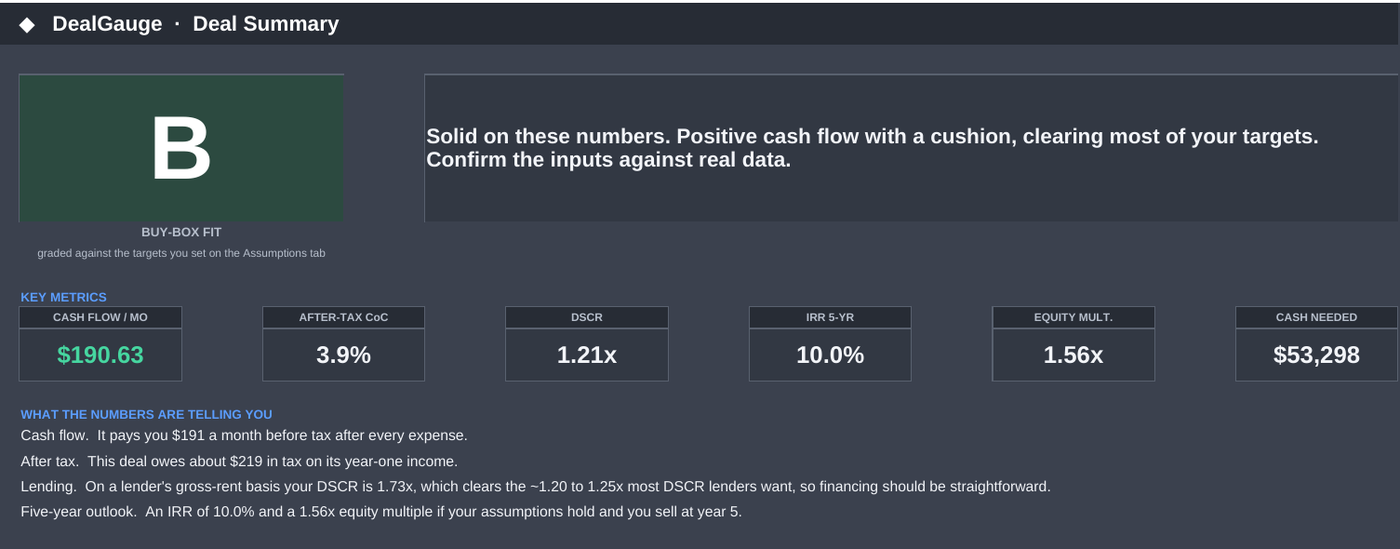
This grade is year one. The Investor Model shows years one through five for this exact deal, after tax, with IRR and three deals side by side. $49 once, thirty day refund.
The free grade answers today. The Investor Model answers the next five years.
Professional-grade spreadsheets you download once and own forever. Every cell unlocked, every formula visible. No subscription, no login, nothing that expires.
See five years ahead
Projections with IRR and equity, an after-tax view, and a sensitivity grid that shows what happens when your assumptions move against you.
Compare deals side by side
Three properties under identical rules, plus a BRRRR planner with a rehab budget and refinance scenarios.
Own the arithmetic
It is Excel. Works in Google Sheets and LibreOffice. Take any number apart and check it, because nothing is hidden.
One payment. Yours forever.
The calculator is free and always will be. If you want to go deeper than one property at a time, there is one paid product, at one price.
- Grades any deal A to F after every real expense
- Your walk away price, with the binding constraint named
- Cash flow, cash on cash, cap rate and both DSCRs
- Every formula published on the methodology page
- The Investor Model, ten tabs, including a five year projection, an after tax view, a BRRRR planner and three deals compared side by side
- The Investor Field Guide, the written manual for the model
- The AI Research Prompt Pack, with a verification step
- Free updates forever, and no subscription
- Our beginner guide, Before Your First Rental, is free to anyone. You do not have to buy anything to read it.
Thirty days. Full refund. You keep the files.
Built for some people. Honestly not for others.
DealGauge is for you if
- You are about to buy your first rental and want a straight answer before you offer.
- You analyze deals regularly and are tired of tools that divide by the down payment alone.
- You own doors already and want every property, and its refinance math, in one place.
- You would rather own a spreadsheet than rent a login.
It is not for you if
- You want an app that pulls listings and comps for you. This connects to nothing.
- You want to be told a deal is good. It regularly says no.
- You are looking for a course, a coach or a community. There are none.
- You do not open spreadsheets.
Free: the beginner guide, the 12-point checklist and this quarter's market report
Before Your First Rental covers what a rental actually costs to own and the arithmetic most first-time buyers get wrong. You also get the checklist of what to verify before you offer, and a national rent, price and rate read. All three download instantly on the next page, with no confirmation click.
FAQ
Is DealGauge free?
Yes. The grade, the verdict, the metrics, the rent breakdown and your walk-away price are all free, update as you type, and work on as many properties as you like. No account. The email box is only for the checklist and market report. The full Investor Model is a separate one-time purchase.
What does the grade mean?
A 0 to 100 score across cash flow, cash-on-cash, financeability and cap rate, mapped to a letter. A and B are strong, C is marginal, D and F lose money or barely break even. Every weight and cut-off is published on the methodology page. It is an estimate, not advice.
What is the walk-away price?
The highest price at which this deal still satisfies all three targets: $150 a month in cash flow, 8% cash-on-cash, and a lender DSCR of 1.20. Whichever binds first sets the number. Property taxes are re-estimated at each candidate price.
Why does it show two DSCRs?
DealGauge shows a strict DSCR after all costs, which is annual net operating income divided by annual principal and interest, and a separate lender DSCR on gross rent, which is what a DSCR lender actually underwrites; most look for roughly 1.20 to 1.25. The strict number is shown because it is the honest one, and on any realistic expense load it reads lower.
Which expenses are included by default?
Vacancy, repairs and maintenance, capital expenditures for big-ticket items, property management and cash reserves. These are the costs that quietly turn a positive deal negative, and they are all in by default. The rent bar in the full breakdown shows exactly where the money goes.
Why is the cap rate lower than a broker's?
DealGauge sets aside a capital expenditure reserve inside operating costs before it calculates cap rate, so the figure reads roughly a point below a broker-quoted cap rate on the same property. A 5% DealGauge cap is about a 6% broker cap. Same property, measured more cautiously, which is why the grade awards full cap rate marks at 5% here.
Can I put this calculator on my own site?
Yes, free, with no account and no sign-up. Copy one line of HTML from the embed page. It carries a small "Powered by DealGauge" link and nothing else.
Know your number before you offer.
Grade a deal free in the calculator above. If you want the full five-year arithmetic behind the grade, the Investor Model is one payment and yours forever.